If you’re replacing a brine tank, you’ve probably noticed there are two shapes to pick from — square and round. It’s a fair question, and a common one. The short answer: for most homes, either one works just fine. The real differences come down to space, salt capacity, and a little bit of maintenance. Let’s walk through it.
The Quick Answer
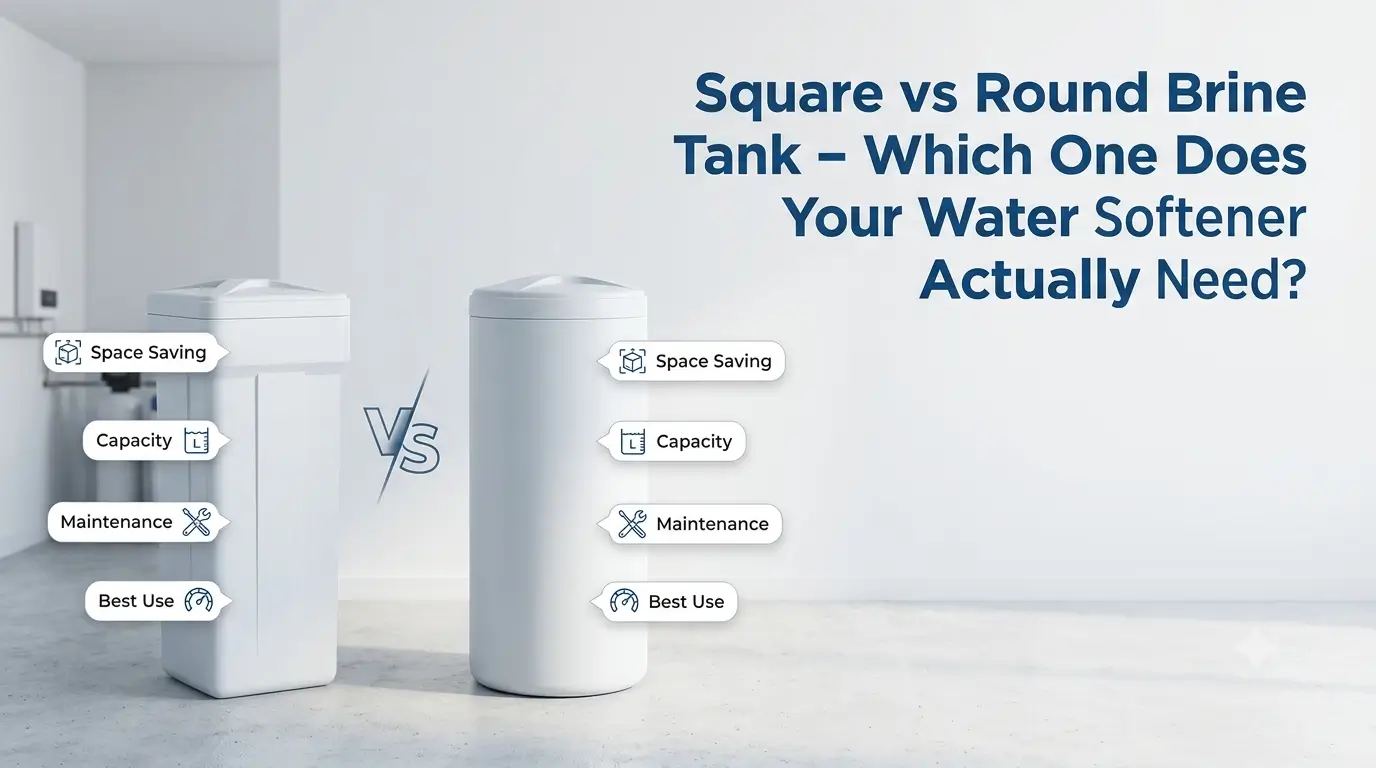
Square brine tanks fit better in tight utility rooms and use floor space more efficiently. Round brine tanks are the more common residential choice and tend to resist salt bridging slightly better, since there are no corners for salt to pack into. Neither shape changes how well your softener regenerates, as long as the tank holds enough salt for your system.
Now let’s get into the details, because “it depends” isn’t much help when you’re standing in your utility room trying to make a decision.
Space: Where the Square Tank Wins
This is the biggest practical difference. Square and rectangular tanks use corner and wall space more efficiently than round ones. If your softener sits in a tight spot — a narrow utility closet, a corner behind the water heater, a crawl space — a square tank often fits where a round one won’t. That’s really the main reason square tanks show up so often in confined installations.
Round tanks need a bit more clearance, but they’re also the more traditional and widely available shape. If space isn’t a major constraint in your setup, this point mostly cancels out.
Salt Bridging: Where the Round Tank Has a Slight Edge
Salt bridging happens when a hard crust forms above the water line inside the tank, leaving an empty pocket underneath. When that happens, your softener draws water but no actual brine — because the salt above the crust never touches the water below it. The result: hard water gets through even though the tank still “looks” full.
Square and rectangular tanks are sometimes slightly more prone to bridging, mainly because many of them taper narrower at the bottom than the top. That taper, combined with square corners, can make it a bit easier for salt to pack and crust. Round tanks don’t have corners, so salt tends to settle more evenly.
To be clear — this isn’t a dealbreaker either way. Bridging is far more about salt quality and humidity than tank shape. Using a clean-dissolving salt (like solar salt crystals or a high-purity pellet) and checking your tank every few weeks solves this regardless of which shape you own.
Salt Capacity: Comparable, Just Different Proportions
Both shapes come in a wide range of sizes, and capacity depends more on the dimensions than the shape itself. A typical 15″ x 36″ square tank and an 18″ x 33″ round tank both fall in a similar 200–275 lb range, which covers most residential softeners without needing frequent refills.
As a rough guide:
| Household / Softener Size | Typical Tank Size | Approx. Salt Capacity |
|---|---|---|
| Small to medium (24,000–32,000 grain) | 15″ x 17″ or 15″ x 30″ | 150–200 lbs |
| Standard residential (32,000–48,000 grain) | 15″ x 36″ or 18″ x 33″ | 200–275 lbs |
| Large households / well water (48,000+ grain) | 18″ x 40″ or larger | 300+ lbs |
One thing worth knowing: going bigger isn’t automatically better. An oversized tank means slower salt turnover, which can actually increase your risk of bridging and mushing. Match the tank to your softener’s grain capacity rather than just buying the largest one available.
What Actually Matters More Than Shape
Honestly, shape is a smaller factor than most people expect. These three things matter more for how well your brine tank performs, regardless of whether it’s square or round:
- Correct sizing for your softener’s grain capacity — undersized tanks run out of salt too often; oversized tanks waste space and encourage bridging
- Salt quality — high-purity pellets or solar salt crystals dissolve cleanly and leave little residue, which cuts down on mushing and bridging in either shape
- Routine maintenance — checking salt levels every few weeks and keeping the tank at least a third full prevents most of the problems people blame on tank shape
So Which One Should You Get?
Here’s the practical way to decide:
- Choose square if you’re working with a tight utility space, replacing an existing square tank, or your softener came with a square tank originally (many Fleck and Autotrol setups do).
- Choose round if you have the floor space, want the more traditional setup, or you’ve had bridging issues in the past and want the shape that resists it slightly better.
- Match your existing tank if you’re just replacing a cracked or worn-out one — same shape, same footprint, no need to adjust your plumbing connections or brine line routing.
In most cases, homeowners replacing an existing tank stick with the same shape simply because it’s a drop-in swap — no re-routing the brine line, no adjusting the softener’s location. If you’re setting up a new system from scratch, space is usually the deciding factor.
Frequently Asked Questions
Does tank shape affect how well my water softener works?
No. As long as the tank holds enough salt for your softener’s grain capacity and the internal parts (float valve, brine well, pickup tube) are working correctly, shape doesn’t affect softening performance.
Can I switch from a round tank to a square tank, or vice versa?
Yes, as long as the replacement tank has compatible brine well and fitting connections. You may need to adjust the brine line length slightly depending on the new tank’s placement.
Which shape is more affordable?
Square and round tanks are usually priced similarly for the same salt capacity. Price differences typically come down to capacity and included parts (float valve, grid, brine well) rather than shape.
Browse Our Brine Tanks
Whether you need a square or round replacement, we carry complete, ready-to-connect brine tanks with the safety float valve, brine well, and pickup tube already included.