
Description
Standard water filters are good at a lot of things — chlorine, sediment, odor — but fluoride isn’t one of them. Regular coconut shell or charcoal-based carbon simply doesn’t have the right structure to bind fluoride ions. Bone char carbon does. That’s the entire reason this filter exists, and it’s what sets it apart from the more common whole house carbon systems.
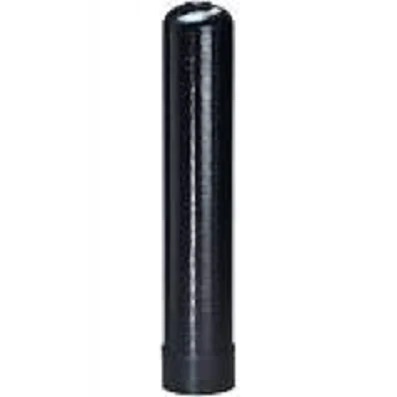
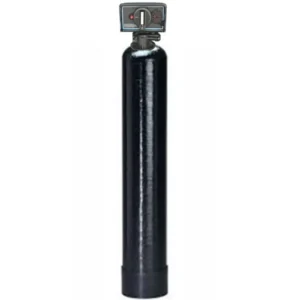
This compact system uses a calcium-based bone char media inside an 8″x35″ FRP tank, small enough to work well in a condo, small home, or anywhere space is at a premium — without giving up real fluoride reduction capability.
What Makes Bone Char Different
Bone char is produced by charring animal bone at high temperature, which leaves behind a carbon structure supporting something called a hydroxyapatite matrix — a calcium phosphate compound with surface ions that fluoride can readily exchange with. In plain terms: fluoride ions get pulled out of the water and held onto the bone char media through a combination of adsorption and ion exchange. This is the accepted mechanism for how bone char reduces fluoride, and it’s the reason bone char shows up in fluoride-specific filters when standard carbon doesn’t.
Beyond fluoride, this filter also reduces hydrogen sulfide (the “rotten egg” smell some well water carries) along with a range of everyday chemicals and odors.
Additional Contaminants Addressed by Bone Char
Independent testing on bone char’s removal efficiency for heavy metals — conducted courtesy of Glasgow University, UK, and bone char manufacturers — has identified the following as contaminants bone char carbon is commonly used to address:
| Contaminant | Contaminant |
|---|---|
| Fluoride | Aluminum |
| Arsenic III | Arsenic V |
| Cadmium | Chromium III |
| Chromium IV | Copper |
| Lead | Mercury |
| Nickel | Silver |
| Zinc | — |
Important note: these additional contaminants are not certified by WQA or state standards for bone char carbon. This table reflects testing results and manufacturer recommendations, not formal certification. The contaminants listed here may or may not be present in your specific water supply — a water test is the only way to know what’s actually in your water.
How Whole House Filtration Protects Your Whole Home
Because this is a point-of-entry system, it treats water before it reaches any faucet, shower, or appliance in your home — not just your kitchen tap. That matters for fluoride specifically, since exposure isn’t limited to drinking. Fluoride and other chemicals can also be absorbed through the skin or inhaled as vapor during a hot shower. Treating the water at the point it enters your home addresses all of these exposure paths at once, not just the water you drink.
The larger bed depth in a tank-based system like this one also means more contact time between the water and the carbon, which generally translates to more thorough filtration than a smaller cartridge-based filter — without causing the pressure drop you’d get from a solid carbon block at the point of entry.
Beyond fluoride and the metals listed above, the carbon component of this media also works like standard activated carbon — reducing volatile organic chemicals (VOCs), pesticides, herbicides, chlorine, benzene, trihalomethane compounds (THMs), radon, solvents, and a wide range of other chemicals found in tap water. Activated carbon is one of the most effective natural adsorbents available; a single pound carries roughly 125 acres of surface area, giving it enormous capacity to bind chemical compounds as water passes through.
Specifications
| Feature | Details |
|---|---|
| Media Type | Bone Char Carbon (Calcium-Based) |
| Media Volume | 1/2 (0.5) Cubic Ft |
| Tank Size | 8″ x 35″ FRP Vessel |
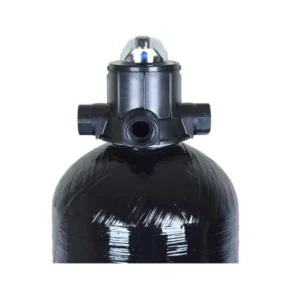
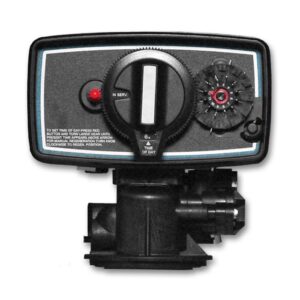
| Valve | 1″ In & Out Valve |
| Primary Function | Fluoride Reduction |
| Also Reduces | Hydrogen Sulfide, Chemicals, Odors, VOCs, Chlorine, THMs |
| Additional Contaminants (Non-Certified) | Arsenic, Lead, Mercury, Aluminum, Cadmium, Chromium, Copper, Nickel, Silver, Zinc |
| Installation Type | Whole House / Point of Entry |
| Best For | Condos, small homes, or space-limited installations |
| What’s Included | 1 × 8″x35″ FRP vessel, 1 × 1″ In/Out valve, 1/2 cu ft bone char carbon |
Who This Filter Is For
- Households with fluoridated municipal water looking to reduce fluoride exposure across the entire home, not just drinking water
- Condo owners and small homes that need real filtration capability without a large tank footprint
- Well water households also dealing with hydrogen sulfide odor alongside fluoride concerns
- Anyone wanting broad-spectrum chemical reduction — VOCs, chlorine, pesticides — in addition to fluoride
Frequently Asked Questions
Why can’t regular carbon filters remove fluoride?
Standard coconut shell or charcoal carbon doesn’t have the right molecular structure to bind fluoride ions effectively. Bone char carbon contains a hydroxyapatite matrix — a calcium phosphate structure — that fluoride ions can exchange with, which is why bone char is used specifically for fluoride reduction.
Is this filter certified to remove arsenic and heavy metals?
The fluoride reduction properties of bone char are well established. The additional heavy metal and contaminant reduction listed is based on testing conducted with bone char manufacturers and Glasgow University, but these additional contaminants are not certified by WQA or state standards. Treat this as supplementary reduction potential, not a certified guarantee.
Will this system work for a small condo or apartment?
Yes — this is specifically sized as a compact system for space-limited installations like condos and smaller homes, while still using a full 1/2 cubic foot of bone char media.
Does this filter cause low water pressure?
No. The larger bed depth of a tank-based system like this one provides thorough filtration without the pressure drop associated with solid carbon block filters at the point of entry.
Get real fluoride reduction where a standard carbon filter can’t — sized to fit even a compact home.

Reviews
There are no reviews yet.